Showing posts with label photographs. Show all posts

7.20.2012

Night Animals


Animals visiting the Big Hole Project

Red Fox ( Vulpes vulpes)
*Low Res. image caught by night cameras
One of the fringe benefits of my land building project is having the curiosity of learning what wildlife is using the new land.  I set up a remote camera to find out and was rewarded with quite a diversity of wild creatures and some not so wild.  With my 1,379th bag of yard waste deposited on July 9th, I have created 720 square feet of new level land that was once a steep crevasse.  My favorite mammal to walk through the infrared beam of the camera was a sleek and well furred red fox, a mostly nocturnal animal probably looking for mice utilizing the composting leaves and grass clippings as a home. The coyote came by for the same reason.

Raccoon (Procyon lotor)
*Low Res. image caught by night cameras

The opossums, armadillos and raccoons that passed the camera were looking for food too, like insects for the armadillo.  I have found many species of invertebrates using the giant compost pile.  Corn, I put out for the deer also brought in the opossum and coon.  I got one shot of a raccoon inspecting a bag of leaves I hadn't emptied yet.  White-tailed deer have been the most numerous visitors.  I have over 500 pictures of deer, mainly does, but a few nice bucks. They quickly get used to the camera clicking and utilize the area nightly.

At night I have also seen a cottontail rabbit, my neighbors cat, numerous dogs. In the day, grey squirrels, crows, blue jays, doves, chickadee and many other birds drop by.  I also catch an occasional human coming down to inspect the progress of my project.

Again I tie my project into the vanishing wetlands of coastal Louisiana, the habitat there is a prolific conglomeration of wildlife.  My hole project is the same as layers of yard refuse saved from the landfill are making habitats for a diverse array of creatures.  See more pictures of night creatures here.

6.18.2012

The Big Hole Project


My wife thinks I am half crazy dragging bags of leaves, grass clippings and other yard debris to an erosion gap in our creek.  Maybe she is right, for I have just unloaded bag number 1,311 into that hole.  All of these bags were collected since June of 2011.  That’s 108 bags per month I have saved from the Baton Rouge landfill.  Estimated to be 26,000 pounds of good organic material not wasted. See more pictures.
Adam Aucoin stand in the hole in June of 2011,
since then 1. 311 bags of leaves  have been put in.

Why?  It started on September 1, 2008 when the winds of Hurricane Gustav knocked down a pine tree, 3 foot in diameter and over 80 feet tall into the above mentioned gap.  It extended into my creek.  I was immediately sad to lose such a big tree and especially so because that gap was my trail to the stream. I solved part of the problem by trimming the limbs off the tree so I could walk down to the creek on top of it. A little more than two years later this became dangerous as the tree rotted.  On May 29, 2011 my stepson Adam and I sawed the pine log into four foot pieces and left them in the hole. A few days later I started throwing nearby limbs and branches on the logs. Brainstorm!  I could see the crevasse totally filled up, making a nice view point over the creek and creating 720 square feet of usable land.
CC stands on the newly accreted land after many bags
 of leaves and grass clipping have been put in.


Branches would take a long time so another idea came to mind as I headed to my office and saw some garbage bags by the street full of grass clippings.  I had collected leaf bags in the fall for years to make compost.  I decided to start collecting bags of yard refuse and fill the crevasse.  With a combination of grass, leaves, sticks and a little dirt every now and then, this concoction of materials will decompose faster than just the logs, limbs and branches.  Furthermore, it has the added advantage of keeping those full bags of valuable vegetable matter out of the land fill.  I made my first entry in my hole ledger on June 5, 2011.  Twenty-one bags of grass went into the hole.  I quickly found out who had the best bags of stuff in a six block radius of my office. So in just a few minutes each Monday on the way to work I could obtain 20 to 30 bags.

So working like a beaver, engineering with layers of leaves, grass clippings and fallen limbs, I began filling that eroded crevasse. It was about 18 feet wide and 40 feet long.  It starts about 4 feet deep and reaches 15 feet deep by the creek. Today, I can walk out about 22 feet on solid ground and another 10 on a spongy surface of compacting leaves.  This leaves only 8 feet left to reach the bluff above the creek.  That will be the hard part, developing a firm vertical bank.

I know as it decomposes, it will sink, compact and subside just like the Louisiana coast and I just like the Mississippi River will keep adding layers until I reach the height and compaction I need.  Unlike the Louisiana coast which always needs new sediment, I think I will reach a point where I no longer have to add.

It's a crying shame that we do not let the Mississippi River get its valuable sediments from the heartland of America into our beautiful and valuable marshes anymore and drag our feet in making that right.

It took 6,000 years of Mississippi River sediments from the heartland of America to build 8,000 square miles of coastal Louisiana.  It will take me about a year and a half to make a 720 square foot plaza above my creek and save the landfill about 2,000 bags of leaves and grass.  As I sit out on my newly accreted land, I think maybe, just maybe this hole project be the inspiration to getting the valuable sediment out of the Mississippi and back into the coastal wetlands.
Link to Baton Rouge Recycle

4.20.2012

Oil Flow Anniversary


Today we remember again what can happen when we are careless, greedy and just plain stupid.  I look back to the worst work of my photographic career. I spent most of my time two years ago on the Louisiana coast while the oil was flowing.

The boom did not work very well

It  came from one mile down, diluted by dispersants and still making its way to pollute the waters, dirty the beaches, and torture the fauna. I am worried about the drop in egg production on some of the prey species (minnows) of fish.


One of the many oil soaked young Brown Pelicans

More of my photographs on this sad time can be seen on an i-Pad app HERE.

On a positive note, I attend a luncheon celebrating the 25th anniversary of the Louisiana Nature Conservancy yesterday. Many attended that have done so much to preserve and set aside valuable habitat in our great state. They are my favorite conservation group as I think the best way to save flora and fauna is to buy land and that is exactly what the LNC does. Skipper Dixon and Nancy Jo Craig, two of the founders asked me to serve on the board of which I did for a few years I also made them a slide presentation about the diversity of Louisiana habitats.  Robert Barham, Secretary of the Department of Wildlife and fisheries gave an entertaining talk at the lunch. With groups like this, the Audubon, the Sierra, the sports fishing and hunting community we will be able to take care of one of Louisiana’s assets, simply put as the “Great Outdoors”.

3.06.2012

Spring

Although it is 15 days until official spring, I say it is here now.  At least it is in Baton Rouge where the azaleas are in full bloom and also in West Feliciana Parish where the dogwoods are bursting in their white splendor. Not everybody is warm, for I know my friend Renny Russell at 8,000 feet in the northern New Mexico Mountains is still knee deep in snow.

I love the azaleas for photography for they are such a captive subject and in so many colors ranging from pure white to deep red.  I encourage students in my workshops to look for subjects like this so they can practice their technique and composition. It helps before a big trip in the Atchafalaya Basin or the Grand Canyon.

Multi-colored Azaleas

Another indicator to the blooming season is my chickens. They get stingy in the winter and slow way down in their egg laying duties. December through late February I was getting one egg every other day, three to four a week out of 7 full size hens and 4 bantam hens. That’s hardly enough yolk to make a joke. A few days ago they popped back into high gear and we are eating our fill and giving eggs away to friends again. There is a variety in my hen house from the calm Buff Orpington laying light brown eggs to the sassy Araucana laying blue eggs.  I have a lot of shades of brown eggs and tiny white eggs from my bantams.  All good.

Colorful mix of fresh eggs

On the way to the office to post this blog, I passed a neighbor’s pasture and saw a new born filly stand for the first time, nurse and run with her mother.  Amazing for only a few hours old. 

Filly standing up for the first time

After I took photographs and started for the truck, I heard honking high above and saw an undulating V of snow geese heading due north.  Yes, spring is in the air.

Flock of snow geese heading north

9.20.2011

Fall Hummingbirds and Surprise Lilies

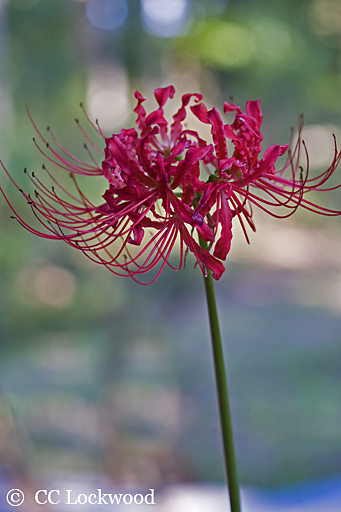
Fall officially begins on Friday and I can already feel it in the air. We have had a few cold fronts that actually cooled off the nights enough to turn off the AC.  You don’t need a weatherman or calendar to let you know the best season is here, just the plants and the birds.  The summer garden is done, the muscadines ripe and dropped and the sugar cane is taller than my topknot.  The plant that really tells me fall is here is the bright red spider lily that some call the surprise or hurricane lily.  It pops up out of nowhere and in my yard there is always a new one or two not near enough to be propagated by last years. 

Surprise Lily

The cardinal flower is another.  I have a friend that calls it the summer’s end flower.  Its cardinal red also gives a spurt of color to the forest that will slowly lose its leaves throughout the fall months.

The birds are harbingers of the seasons too.  You can look in Dr. George Lowery’s book, Birds of Louisiana and see a list that shows which are here when...or better yet you can go out doors and look.  The blue-winged teal are here, the blackbirds are flocking, the warblers are leaving, and best of all the hummingbirds are flocking, or better put, there is a charm of ruby-throated hummingbirds in my backyard.  
When my one hummingbird brought in two, then three then more friends I got out my extra feeders. For eight days I have had six feeders out and the one by the kitchen window has had fifteen birds within inches of it at one time.  

Eleven Ruby-Throated Hummingbirds at my kitchen feeder.

I am estimating seventy-five birds in my back yard.  This will last for a few more days, then groups of them will head off to the south.  I clean the feeders, store them, enjoy the cool air and watch the leaves slowly fall, for fall is in the air.

8.03.2011

Atchafalaya Memories

On August 17, 2011 LPB will broadcast my Atchafalaya Movie that originally premiered in the spring of 1977 at the LSU Student Union Theater to a standing room only crowd of 1,400 people.  LPB is going to show it during their summer fundraiser evening.  This brings back fond memories of my carefree early days in the Basin.

Meeting the people I called swampers was a big part of those recollections.  Calvin Voison and Gwen Carpenter Roland were two of the first swampers I met and we became fast friends.  I just saw a post in Gwen's Facebook page that told about her favorite picture I took of her. In the photo she is looking out the window of Pajo Curry's shack on the Atchafalaya River. 


Gwen Carpenter at Pajo Curry's shack

I wasn't a people photographer at all when I first entered the Atchafalaya.   The long stretches of calm and peaceful days out there exploring alone in my canoe made me appreciate the times I ran into the swamp people. I learned to photograph them from afar and not get in their way.  And in this way I learned people photography.

I'll post some more memories on my early days in the swamp before LPB shows, Atchafalaya: America's Largest River Basin Swamp.

7.27.2011

Black Widow

I can’t remember how long it has been since I have seen one, but when I turned over the rain barrel by my greenhouse it jumped out at me like coal on snow.  It was a female black widow spider hiding on the wooden frame below the barrel.  The red hour-glass contrasted brilliantly against the shining black exoskeleton on her abdomen.  I carefully photographed her and wondered if she could or would bite one of my chickens or if my chickens would eat her if they had the chance.

Female Black Widow Spider; Latrodectus mactans

6.09.2011

High Water in the Atchafalaya

It’s a hot day with big beautiful cumulus clouds.  Very humid, the water is brown but not heavily silted as I start in the Classic Bayou Canal, a place I have paddled and motored 300 times.  It is 12 plus feet deep; I have seen it dry.   Sycamore, persimmon, willow and pepper vine close it into a tight jungle of vegetation, so different than the 70s.   The birds are varied and full of song.  At one point I smell a rotting animal.  I am sure some have drowned.  On I idle slowly, a blue dragonfly lands on my bare foot.   I stop listen and think of all the days like this, peaceful – and very quiet in its own way and alone. 
The wind is cooling; the deep green of the tree tops sway slightly. As I see a beaver resting on a floating bald cypress log, I know the terrestrial wildlife that did not move out in time is having a hard life. The birds and aquatic life on the other hand dance with joy. A beaver is an aquatic creature, swimming and building dams, but when the water goes over its den too quickly for him to rebuild higher…life is different.  I move closer and get good shots and see this dazed look on its face. He is confused with no dark hole to crawl into during the daylight hours.


A little later I come on to a patch of land 21 feet by 15 feet and see the backs of two armadillos protruding from the dirt.  I stop and photograph them while four more come crawling out of a hole that is not much more than a depression.  The water table is about 10 inches down, so they cannot dig proper holes.  Lucky for them the insects are kind of trapped here too.  Food!


After dark, I was just falling asleep on a friend’s small houseboat.  It was a fairly primitive craft, but was mosquito proof.  I heard a human-like voice and something bumped the boat.  I leaped out of bed and after getting no reply to “Whose there!” I shine my light out into Bloody Bayou and see something that looked kind of white and swimming.  It came toward me and the white was actually tan.  It was a White-tailed Deer, a doe and she was swimming like an Olympic athlete.  She came right up to the boat.  Looked like she wanted to climb aboard, but the deck was too high.  I thought for a minute that she might want me to lift her up on deck, but I knew that would turn into a real mess.


I first met the Atchafalaya in the high water years of 1973-75.  It was fun remembering those great days when I could paddle about everywhere and today I could again.  The water is already dropping.  The system is getting a good flushing of fresh water.  The terrestrial animals will bounce back and the Basin remains as my favorite place in the whole world and a gem in Louisiana’s portfolio.

3.15.2011

Three Different Days

Life is different and exciting for a natural history photographer. Take three days last week. On Thursday I was in my bateau (cajun flat boat) cruising the bayous in Terrebonne Parish looking for eagles, then on Friday I was in my backyard taking pictures of my chicks that had hatched 12 days earlier and finally on the weekend I was in New Orleans photographing parades for a project on the good things of Louisiana.

I left Bayou Black Marina for my eagle search dressed warmly as it's always colder in a boat moving over the 60-degree water. The multitude of herons, egrets, ibis, coots, moorhens and anhinga that were here during the Eagle Expo were gone to mate and build their nest in rookeries. The eagles were still here. I saw 22 adults and 7 immature on a 50-mile boat tour. During that boat ride I found 6 nests I had not seen before. The eagle recovery plan is working well here in Louisiana.


On February 18 I hatched nine Araucana chicks in my incubator, the eggs came from my friends, the Roland’s, who live down the road from my house. The eggs are blue so when these grow up I will be adding beautiful blue eggs to the beige, brown and white I now get. The chicks make great photo subjects also. Right now I have 21 eggs in the incubator, which should hatch this Thursday. This is a mixed batch. I collected eggs from friends that have a number of different varieties. I’ll post pictures of all the different looks when they hatch.


After putting my Araucana chicks back in the brooder, I headed out to New Orleans to photograph some parades, especially the second line walking parades. My good friend Al McDuff told me about the Red Beans and Rice Walking Parade and that was my main goal. The crew met at Port and Royal Street at 1 PM and soon gathered to about 100 members dressed in costumes decorated in red beans, rice and other colored beans.


Some were very elaborate and beautifully done. As they walked, danced and jived down Royal Street, many Marti Gras revelers joined the route. In all I shot 1,400 photographs in three days of Mardi Gras. The digital world makes my shutter finger more active. This girl’s bean decorated mask was one of my favorites.


3.01.2011

1977 Atchafalaya Movie Premiere Print!

March's Print of the Month is a very limited original (we have less than 30 left) print from my 1977 Atchafalaya: America's Largest River Basin movie premiere. 

About this print:
This print is VERY limited with less than 30 remaining!
This is an original 11” x 17.5” movie print advertising  CC Lockwood's premiere of his 1977 film  Atchafalaya: America's Largest River Basin Swamp.  Directed by C.C. Lockwood and Marty Stouffer.  Produced by C.C. Lockwood.  Each is printed on a lovely slightly textured thick matte paper and is hand-signed in silver by CC Lockwood. Get your little piece of Atchafalaya history today. This unique vintage black and white advertising movie print looks fantastic matted and framed.  These won't last long! 

More about this print from CC Lockwood:
"In the late 70s, as I was working on documenting the Atchafalaya Basin through my photography, the Corps of Engineers planned to deepen the channel of the Atchafalaya River in the interest of flood control.  But, in fact, the plan would only have complicated flooding problems.  Ultimately, it would be the ruin of a vital wetland.  I had to find a way to let more people know how valuable the Basin was.  So, I extended my sojourn another year, now with a 16-mm movie camera and the help of my friend Marty Stouffer, who was successfully making educational wildlife films at the time. 

The film was wildly successful.  The LSU Union Theater was packed to the gills for its premier showing; with the theater's 1,315 seats and its aisles filled, some 400 people were turned away.  Congressman Henson Moore spoke, along with Sandra Thompson, executive director of the Governor's Atchafalaya Basin Commission.  The Copas Brothers played songs from the soundtrack before we showed the film.  Louisianians were thirsty to learn more about the basin."
-CC Lockwood

Click HERE to purchase one of these fantastic limited prints!

2.15.2011

Japanese Magnolias

Boom, a burst of pink and purple brightens the streets of Baton Rouge.  The Japanese Magnolias are ready to erupt any day now in these wild colors contrasting starkly with the browns and grays of winter vegetation. Soon, you will be able to see some of my favorite trees on Highland Road.  The bloom is late in my book, as I have seen them pop out as early as January 8th in warmer years.  South Louisiana has had two cold winters sandwiching a hot dry summer of 2010. Pretty weird that we had no freezes or frost in the winter of 2008/09, then about 20 last year and are working on 20 this year too.  These have been cold hard freezes for the south; my birdbath has had an inch of ice on it five times this winter.  Last year we had two 5 inch snows.

Weather though is one of my tools. As a nature photographer weather along with light makes or breaks a photograph. A colleague of mine says that there has been a picture taken of everything in nature. (Except for the Ivory-billed Woodpecker) I won’t totally agree with that, but you do need some spectacular light and great technique to get a different rendition of a great egret or a grove of bald cypress trees. Rain, wind, cold or snow makes it hard on the cameras and the body, but that’s when you need to be out there working the many beautiful habitats of Louisiana.  


Finally some color is on its way. Get ready for spring.
Be sure to also check out the WEATHER photo album I recently posted at my Facebook page: HERE

1.08.2011

Big Cypress Slough

To me the only thing better than paddling slowly through a forest of bald cypress trees would be to go back in time and paddle through a virgin stand of the same.  Today though I was with some huge trees. The majestic cypress I drifted by were ancient; their fluted and buttress bases were thirty, forty and some even fifty feet in circumference. They grew amongst a number of younger trees. Because they did not have a good saw log they escaped the clear cuttings of the early 1900’s.


It was cold and still with blue skies and the reflections of the trees on the clear water made good photos.  Wood ducks flushed ahead of us as we paddled quietly. Great Blue herons squawked as they launched into flight from the treetops. Schools of pan fish scurried ahead. No turtles or alligators showed their face on this winter day, but signs of raccoons and otters were on every floating log.  Occasionally breaking into the sounds of nature we could hear the hum of big tugs pushing barges on the Mississippi or a four-wheeler carrying a deer hunter to his stand. But mainly it was quiet, peaceful and fantastically beautiful.  A boat, water and big trees…what more could I want?


9.14.2010

Print of the Month: September '10

We're trying something new over here starting this month of September 2010:
The Print of the Month. I'm hoping everyone will enjoy it.

Print of the Month #1: 
 "Bonding"

This photograph entitled "Bonding" is our first in  the series of Prints of the Month we are now offering. This signed archival print is available at a special price of $40 until the next Print of the Month becomes available. At that point this print will be available at its regular price of $100.

For more details and/or to purchase your own signed CC Lockwood "Bonding" print visit the
Print of the Month webpage: HERE

If you have any questions please let us know!